
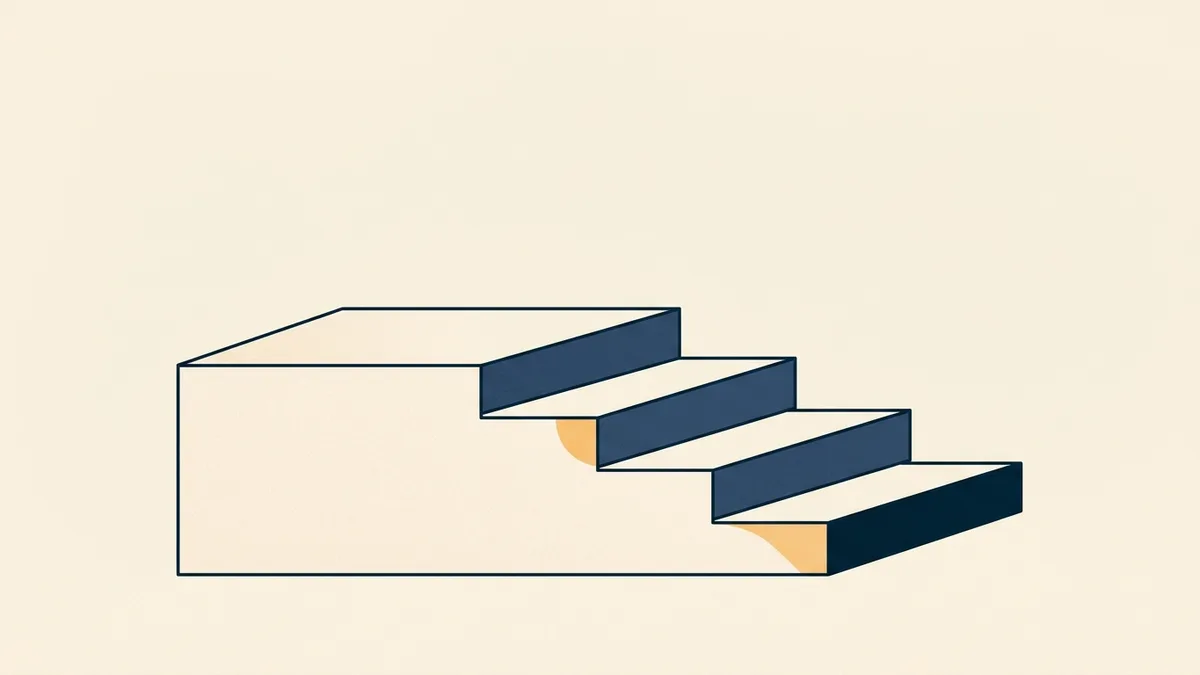
A first license runs in a fixed order: pass PANCE, obtain NCCPA certification, apply for the state license, then DEA and state controlled substance registration, then credentialing and payer enrollment. The first item takes the longest, and graduates who start in the wrong order routinely miss a start date they could have made.
The order is fixed by dependency, not preference. Every step needs the one before it, and the first step is the slowest.
PANCE first, and early
Schedule it as soon as eligibility allows. Not when you feel maximally prepared — as soon as you are permitted, adjusted for a realistic preparation window.
The reason is arithmetic rather than confidence. PANCE sits at the head of a chain four steps long, and every week of delay at the head moves the whole chain by a week. A graduate who sits the exam six weeks later than necessary starts work six weeks later than necessary, regardless of how well everything downstream goes.
Certification, which is fast
Once you pass, NCCPA certification follows quickly. This is the only genuinely quick step in the sequence, and it is the one people budget time for.
The license, which is not
Two to four months in most states, driven by fingerprinting and primary source verification rather than by board processing.
Two things are worth doing here. First, check whether your board accepts an application with results pending — many do, and filing early frequently unlocks the fingerprint packet, which is the step that cannot be compressed. Second, if you are considering more than one state, file them concurrently rather than sequentially. The waits overlap; the effort does not.
Registrations, which nobody plans for
DEA registration, and separately a state controlled substance registration where the state requires one. The state registration usually cannot be filed until your license number exists, and its own processing runs from days to eight weeks.
This is the item most likely to delay a first day, because it sits at the end of a chain that already ran four months and it is routinely started late.
Credentialing and enrollment, which decide the revenue
Your employer handles most of this, and it cannot start before the license. Payer enrollment commonly runs ninety to a hundred and twenty days after a complete file.
So the date you can work and the date the practice can bill for your work are different dates, often by a quarter. Knowing that in advance prevents a difficult conversation in month two.
Choosing where to license first
Most graduates license where the job is, which is correct. If you have a choice, or are adding a second state, weigh compact membership heavily.
A member-state license is a qualifying license — from 2027 it supports privileges into every other member state, which is worth far more than the state it nominally covers. A license in California, New York, Texas, Florida, Illinois, Pennsylvania or Georgia does no work anywhere else, permanently.
That does not mean turning down a job in a non-member state. It means that if you take one, adding an inexpensive member-state license — Missouri at $28, Washington at $50 — is worth considering as career infrastructure rather than as an expense.
What employers get wrong about your timeline
An employer asking when you can start is usually thinking about the license. They are frequently not thinking about the state controlled substance registration that cannot be filed until the license number exists, or about payer enrollment running ninety to a hundred and twenty days after that.
Give them the honest chain rather than the optimistic headline. A start date moved once, early, is a scheduling conversation. A start date moved twice, late, is a different conversation entirely, and new graduates have the least standing to have it.
The single highest-value decision
Schedule PANCE as early as eligibility allows. Everything in this article is downstream of that one date, and it is the only step where a decision you make today moves the whole chain.
Every other optimization — parallel requests, early fingerprints, prepared documents — recovers days and weeks. That one recovers months.
Use the waiting time
Build a complete CAQH profile. Assemble a chronology with no unexplained gaps. Request transcripts. Gather malpractice history and references.
None of it accelerates the license, and all of it turns the downstream steps from three-week document hunts into same-day submissions. That is where a graduate actually recovers weeks.
Common questions
- How long after graduation can a PA start working?
- Four to six months is realistic. PANCE scheduling and results, then a two-to-four-month license, then registrations and credentialing — each dependent on the one before.
- Can I apply for a state license before passing PANCE?
- Some boards accept an application while results are pending, but none will issue without certification. Filing early can still be worth it because it unlocks the fingerprint step.
- When should I schedule PANCE?
- As early as eligibility allows. It is the longest item on the critical path, and every week of delay moves everything downstream by the same week.
- What can I do while waiting for my license?
- Complete your CAQH profile, gather your work and education history, request transcripts, and prepare payer enrollment documents so submission is same-day once the license number exists.
Need Help with Your Application?
We handle the PA licensure process end-to-end — eligibility screening, documents, board follow-ups, and tracking.